

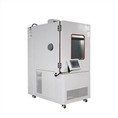


Products Description
High and low temperature test chamber is a kind of test equipment used to test and determine the parameters and properties of electrical, electronic and other products and materials after temperature environment changes under high temperature, low temperature, alternating temperature or constant test.
It is widely used in aviation, automobiles, home appliances, scientific research and other fields, and is a necessary test tool in these fields. The high and low temperature test chamber can simulate the combination of temperature and humidity conditions of the product in the climate environment, such as high and low temperature operation, storage, temperature cycle, high temperature and high humidity, low temperature and low humidity, dew test, etc. Thus used in defense industry, aerospace industry, automation components, automotive parts, electronic and electrical components, instrumentation, materials, plastics, chemical, food, pharmaceutical industry and related products of heat, humidity, cold, dry performance and quality management engineering test specifications. Through these tests, it is possible to evaluate whether the adaptability and characteristics of the product itself have changed under given environmental conditions.

|
Model |
B-TH-80 (A~G) |
B-TH-150 (A~G) |
B-TH-225 (A~G) |
B-TH-408 (A~G) |
B-TH-608 (A~G) |
B-TH-800 (A~G) |
B-TH-1000 (A~G) |
|
Inside size WxHxD (cm) |
40x50x40 |
50x60x50 |
50x75x60 |
80x85x60 |
80x95x80 |
100x100x80 |
100x100x100 |
|
Outside size WxHxD (cm) |
95x145x105 |
105x175x97 |
115x190x97 |
135x185x120 |
145x185x137 |
145x210x130 |
147x210x140 |
|
Temperature range |
0℃~+150℃ |
||||||
|
Humidity range |
20%~98%R.H.(10%-98%R.H/5%~98%R.H is the specific condition) |
||||||
Introduction
LED lighting technology has been widely used in lighting projects because of its characteristics of energy saving and long life. However, due to the lack of a unified industry standard, the quality of LED lighting products on the market is uneven. With the rapid development of the LED lighting industry, the global and domestic have begun to develop relevant testing and evaluation standards to ensure product quality and promote the healthy development of the industry.
Status of international standard-setting
At present, the worldwide research and standardization of LED lighting technology is increasingly being paid attention to. The National Institute of Standards and Testing (NIST) is actively promoting the research of LED lighting test methods, aiming to establish a comprehensive set of LED test methods and standards system. At the same time, Japan has also set up a special "White LED Test Research Committee", focusing on the development of high and low temperature test methods and technical standards for white leds used in lighting, such as high and low temperature cycle test boxes.
In order to take a leading position in the global LED industry, developed countries have invested significant resources in LED standards and testing. These countries pay special attention to the selection of LED characteristic parameters and the study of test methods when developing standards. In addition, the R&D teams of many large international enterprises have also actively participated in the activities of national and international standardization organizations to jointly promote the development of high and low temperature test standards for semiconductor lighting, such as the standards of LED high temperature and high humidity test chambers.
However, at present, the International Commission on Lighting (CIE) and the International Electrotechnical Commission (IEC) have not yet developed standards specifically for LED lighting, and the existing standards mainly involve ordinary LED test methods and lighting standards related to conventional light sources. This shows that standardization in the field of LED lighting is still evolving and needs more research and international cooperation to improve. At present, the test standards of ordinary LED are:
Iec 60747-5 Discrete Semiconductor Devices and Integrated Circuits (1992);
IEC Discrete Semiconductor Devices and Integrated Circuit Components, 5-2: Optoelectronic devices - Classification Characteristics and elements (1997-09).
IEC Discrete Semiconductor Devices and Integrated Circuits, 5-3: Optoelectronic devices -- Test methods (1997-08);
IEC Discrete Semiconductor Devices, 12-3: Optoelectronic devices - Blank Detail Standard for light-emitting diodes for display purposes (1998-02)
CIE127-1997LED Test Method (1997);
CIE/ISOLED strength testing standards.
In the CIE 127-1997 standard issued by the International Commission on Lighting (CIE) in 1997, the concept of average strength for LED strength testing was proposed, and a unified test structure and detector size were specified, which provided an important basis for the accurate testing and comparison of LED performance. Although CIE 127-1997 is not a formal international standard, its ease of implementation and ability to ensure the accuracy of tests has led to its adoption by many major companies around the world. However, with the rapid development of LED technology, the CIE 127-1997 standard failed to cover some emerging LED technology characteristics, such as testing in high temperature and high humidity environments.
In the development of LED standards, Japan has also shown positive efforts. For example, Japan's Nichia company and the United States Lumileds company for LED technology cross-licensing, and plans to jointly develop power LED standards to promote market application and promote the stable development of the LED industry.
In addition, the United States product safety certification and standards setting body UL (Underwriters Laboratories Inc.) is also actively developing a series of LED product safety assessment standards. Eli Puszkar, lighting Planning Business Department of UL, said that in order to ensure that new LED lighting products can be accepted and trusted by the public as traditional lighting equipment, UL has begun to develop safety evaluation standards for LED products. During the development and design of new products, manufacturers need to consider safety issues such as preventing electric shock, fire and physiological hazards.
BOTO's high and low temperature test chamber has an irreplaceable role in the high and low temperature test of LED lamps, which can detect the reliability of products and improve the competitiveness of products.

BOTO specializes in high and low temperature test chambers for more than 20 years, if you have any inquiries please contact us.
Hot Tags: high and low temperature test chamber, China, suppliers, manufacturers, factory, buy, cheap


