





Corrosion Testing Becomes Mandatory for Global Industrial Quality Control
Salt spray test chambers remain the core equipment for accelerated corrosion testing worldwide. Latest industry data shows the global salt spray testing equipment market maintains steady growth, supported by stricter material reliability standards across EV, energy storage, aerospace, communication hardware and plated metal parts sectors. As more products serve coastal, offshore and high-humidity environments, manufacturers and third-party labs are upgrading traditional salt fog cabinets to high-precision, digitally controlled models.
Rising Demand from EV and Energy Storage Supply Chains
The biggest growth engine comes from electric vehicles and energy storage systems. Battery enclosures, high-voltage connectors, chassis fasteners, solar brackets and cabinet sheet metal must pass long-duration salt spray validation to avoid corrosion, sealing failure and safety risks. Many Tier 1 auto and battery suppliers no longer only run simple NSS neutral salt spray tests; cyclic corrosion testing (CCT) combining salt fog, drying and humidity cycles is widely adopted to simulate real coastal climate changes. This trend pushes buyers to select multi-function salt spray chambers instead of basic single-mode machines.
IoT Monitoring, Low Energy Consumption and Standard Consistency
Three clear technical trends dominate 2026 new product launches.
Smart IoT & remote data logging: Modern salt spray chambers support real-time parameter tracking, remote alarm and automatic test report export, reducing manual recording errors and meeting CNAS / ISO audit requirements.
Energy-efficient design: Manufacturers optimize heating and spray systems to cut water and power consumption, matching global low-carbon factory requirements.
Higher test repeatability: Stable temperature, uniform salt fog distribution and automatic brine mixing are now baseline requirements for certified laboratories, following ISO 9227, ASTM B117, JIS Z 2371 and GB/T 10125 standards.
Benchtop, Floor-Standing and Walk-In Salt Spray Rooms
Customer requirements are increasingly diversified.
Benchtop small salt spray chambers: for R&D labs, small hardware, electronic components, batch sampling.
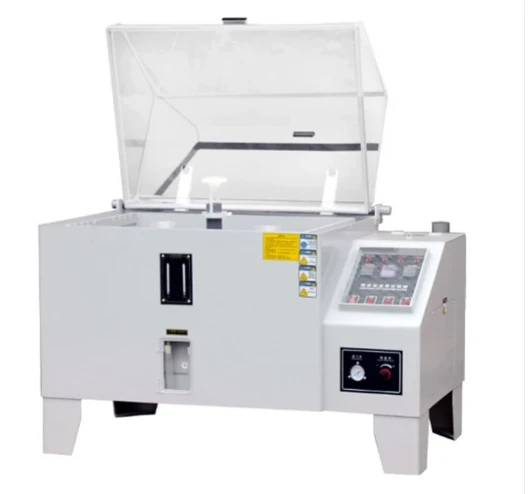
Standard floor-standing salt spray testers: the most popular model for plating factories, coating workshops and quality inspection rooms.
Custom walk-in cyclic salt spray rooms: for large workpieces, battery packs, vehicle modules and complete assemblies, which is a fast-growing custom segment in 2026.
Chinese Test Equipment Manufacturers Gain Recognition
Previously, high-end corrosion testing equipment was dominated by European and American brands. Today, qualified Chinese environmental test equipment suppliers like BOTO deliver stable, cost-competitive salt spray chambers with full standard compliance, English HMI and after-sales support for overseas clients. Many Southeast Asia, Middle East, Africa and Latin America labs now source directly from China for laboratory and production-line testing equipment.
Combined Environmental Simulation Will Be the Next Direction
Moving forward, single salt spray testing can no longer satisfy complex reliability validation. Combined test solutions that integrate salt spray, temperature-humidity cycling, UV aging and condensation will become more common. For equipment suppliers, the competition is shifting from hardware manufacturing to full corrosion testing solution support, including test recipe setup, calibration and long-term technical service.