

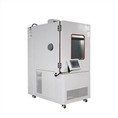


Products Description
The Salt Spray Cabinet uses salt spray corrosion to test the reliability of tested samples. It simulates a salt spray corrosion environment to test the corrosion resistance of materials. It is primarily used to evaluate the reliability of surface treatment processes such as electroplating, coatings, and anodizing. It complies with international standards such as JIS, CNS, and ASTM, and can perform both neutral salt spray (NSS) and acid salt spray (CASS) tests. It is primarily used for weathering tests on industrial products, particularly those requiring simulation of the destructive effects of marine climates on materials.

What's the Function of the Salt spray cabinet?
1. Accelerated Corrosion Testing: The Salt Spray Cabinet uses a high-concentration salt spray environment to quickly expose material defects and shorten testing cycles.
2. Quality Verification: Used to verify that protective processes (such as anti-rust oil and anodizing) applied to metal and non-metal materials and industrial products meet standards.
3. Standards Compliance Testing: Supports various test types, including neutral salt spray (NSS), acetic acid salt spray (AASS), and copper-accelerated acetic acid salt spray (CASS), complying with international standards such as GB/T 2423.17 and ISO 9227.
Standard
Salt spray test cabinet can meet ISO 9227-2017, DIN50021,ISO1456-74,ISO3768-78,ASTM B117-73 GB/T2423.17-2008,GB/T2423.18-2008,GB/T31467.3,SAEJ2334-2016, GB/T10587-2006,GJB150.11-1986,GJB150.9-1986,GB/T10125-1997,GB/T5170.8-1996, JIS And other test Methods designed and manufactured.
What is the IEC standard for salt spray test?
IEC 60068-2-11: Applicable to electrical and electronic products, automotive parts, etc., the Salt Spray Cabinet tests their corrosion resistance in a simulated salt spray environment.
IEC 60068-2-52: The core test is the cyclic salt spray test (Kb), which includes salt spray and damp heat cycles. It is applicable to metal components, coatings, and outdoor equipment.
Specifications
|
Model |
BT-60 |
BT-90 |
BT-120 |
BT-160 |
BT-200 |
|
Inner size (cm) |
60x45x40 |
90x60x50 |
120x100x50 |
160x100x50 |
200x100x50 |
|
External size(cm) |
107x60x118 |
141x88x128 |
190x130x140 |
230x130x140 |
270x130x140 |
|
Inside temp |
Brine test method(NSS ACSS)35°C±1°C/Corrosion resistance test method |
||||
|
Brine temp |
35°C±1°C 50°C±1°C |
||||
|
Test chamber volume |
108L |
270L |
600L |
800L |
1000L |
|
Brine chamber volume |
15L |
25L |
40L |
40L |
40L |
|
Compressed air pressure |
1.00±0.01kgf/c㎡ |
||||
|
Spray volume |
1.0~2.0ml/80cm2/h (Collect at least 16 hours, the average) |
||||
|
Test room relative humidity |
85%RH or more |
||||
|
PH |
6.5~7.2 3.0~3.2 |
||||
|
Spray method |
Programmable spray (including the continuous spray interrupted spray) |
||||
|
Power |
AC220V1Φ10A |
AC220V1Φ15A |
AC220V1Φ20A |
AC220V1Φ20A |
AC220V1Φ30A |
How Do You Maintain the Salt Spray Cabinet?
Daily Cleaning
Clean the equipment exterior and interior after each test or at least once a week. Use a soft, damp cloth to wipe, avoiding strong acids and alkalines to prevent corrosion. Focus on removing salt residue from the spray nozzles, turntable, and salt tank to prevent clogging and affecting spray uniformity.
Test Fluid Management
Strictly prepare the test fluid according to the standard (for example, a 5% sodium chloride solution is commonly used for neutral salt spray testing) using purified water to prevent impurities from interfering with test results. Avoid reusing the solution; replace it before each test. Clean the salt tank regularly to prevent salt crystallization and clogging the system.
Spray System Maintenance
Regularly check the nozzles for unobstructed flow. Rinse with clean water or a soft brush, avoiding strong impacts that may cause deformation. Inspect the spray pipe seals and connectors, and replace any worn parts promptly. Repair the spray pump if it makes unusual noises or has difficulty spraying.
Temperature and Humidity System Maintenance
Regularly calibrate the temperature and humidity sensors (recommended quarterly or semi-annually) to ensure measurement accuracy. Check the performance of the heating system to prevent temperature fluctuations from affecting the stability of the test environment.
Environment and Safety
The equipment must be installed in a well-ventilated, dry location with a stable temperature (15-35°C) and a flat surface, away from heat sources and direct sunlight. Ensure levelness during installation, ensuring that the levelness error does not exceed the specified range.
Hot Tags: salt spray cabinet, China, suppliers, manufacturers, factory, buy, cheap


