




Products Description
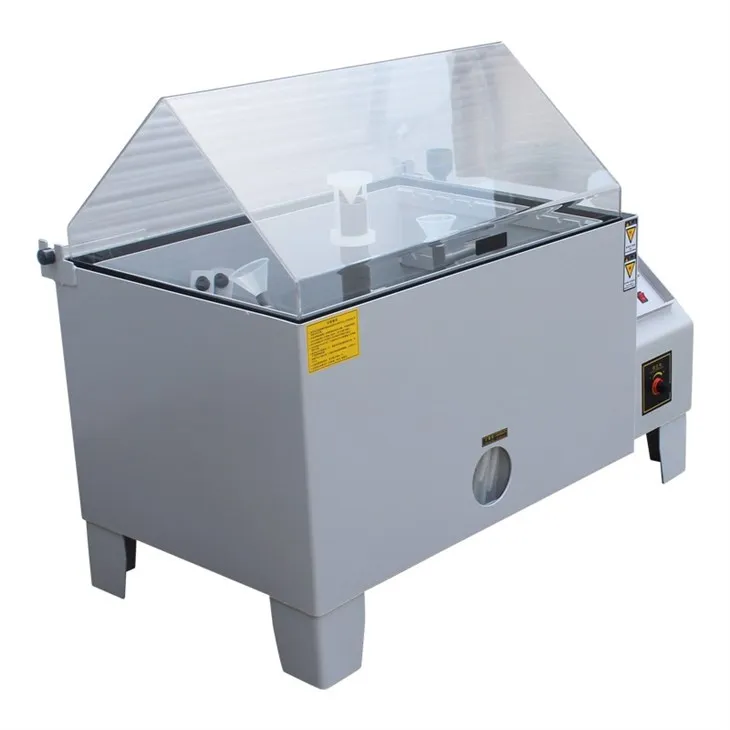
Salt Fog Test Chamber, also known as salt spray test chamber, is a reliability test equipment that artificially simulates the ocean or high-salt humid environment. The working principle of the salt spray test machine is to create a controlled environment filled with salt fog.
This fog is produced by atomizing a physiological saline solution, which is then sprayed onto the test sample.
The concentration and temperature of the salt solution, as well as the duration and frequency of the spraying, can be precisely adjusted to simulate different real-life scenarios. Its core principle is to simulate the destructive effect of salt fog on materials in the natural environment, helping companies to find potential problems in the research and development stage.

Salt Fog test Chamber principle
Salt Fog Test Chamber atomizes a certain concentration of salt solution into tiny particles, and then forms a salt fog environment in the test chamber. The commonly used salt solution is sodium chloride solution, and the concentration is generally 5% or other specific concentrations, which is determined according to different test standards and requirements. The atomization process uses compressed air to blow the salt solution into fine droplets through a sprayer. These droplets are evenly distributed in the test chamber to simulate the salt fog conditions in the marine environment or other salty environments.
Standard
Salt spray test cabinet can meet ISO 9227-2017, DIN50021,ISO1456-74,ISO3768-78,ASTM B117-73 GB/T2423.17-2008,GB/T2423.18-2008,GB/T31467.3,SAEJ2334-2016, GB/T10587-2006,GJB150.11-1986,GJB150.9-1986,GB/T10125-1997,GB/T5170.8-1996, JIS And other test Methods designed and manufactured.
Product Features
1. Salt spray test cabinet use durable hard 8 mm PVC construction, anti-corrosion and easy to clean.
2. Reservoirs with mixing system on stand.
3. Separate heating system apart from salt testing chamber to ensure accurate result and protect circuit.
4. Exposure zone lined with corrosion-resistant PVC sheets.
5. Clear cover allows viewing of test conditions.
6. Peaked cover prevents dripping of condensation onto samples.
7. Water seal and water level protection system.
8. Heated humidifying tower with air relief valve, adjustable tower tip to orient salt fog.
9. Automatic DI water fills to humidifying tower.
10. Digital temperature control.
11. Integral over-protection on heaters.
12. Low water cut-off protection on humidifying tower.
Specifications
|
Model |
BT-60 |
BT-90 |
BT-120 |
BT-160 |
BT-200 |
|
Inner size (cm) |
60x45x40 |
90x60x50 |
120x100x50 |
160x100x50 |
200x100x50 |
|
External size(cm) |
107x60x118 |
141x88x128 |
190x130x140 |
230x130x140 |
270x130x140 |
|
Inside temp |
Brine test method(NSS ACSS)35°C±1°C/Corrosion resistance test method |
||||
|
Brine temp |
35°C±1°C 50°C±1°C |
||||
|
Test chamber volume |
108L |
270L |
600L |
800L |
1000L |
|
Brine chamber volume |
15L |
25L |
40L |
40L |
40L |
|
Compressed air pressure |
1.00±0.01kgf/c㎡ |
||||
|
Spray volume |
1.0~2.0ml/80cm2/h (Collect at least 16 hours, the average) |
||||
|
Test room relative humidity |
85%RH or more |
||||
|
PH |
6.5~7.2 3.0~3.2 |
||||
|
Spray method |
Programmable spray (including the continuous spray interrupted spray) |
||||
|
Power |
AC220V1Φ10A |
AC220V1Φ15A |
AC220V1Φ20A |
AC220V1Φ20A |
AC220V1Φ30A |
What is the difference between ASTM B 117 and ISO 9227?
The main differences between ASTM B 117 and ISO 9227 in salt spray test standards include differences in test conditions, result judgment and actual application scenarios.
Test conditions
ASTM B 117: The test chamber temperature is 35°C, the temperature range of the air saturation tower is 46-49°C, a 5% NaCl salt solution is used, the pH value of the collected liquid is 6.5-7.2, the specific gravity is 1.0255-1.0400, and the solution collection volume is 1-2 ml/h.
ISO 9227: The test chamber temperature is also 35°C, the temperature range of the air saturation tower is 45-52°C, a 5% NaCl salt solution is used, the pH value of the collected liquid is 6.5-7.2, the specific gravity is 1.029-1.036, and the solution collection volume is 1-2 ml/h.
Result determination
ASTM B 117: Focuses on "corrosion area ratio", for example, a corrosion area less than 0.1% is grade A.
ISO 9227: Introduces "corrosion rate calculation", the unit is g/m²·h.
Practical application scenarios
ASTM B 117: Widely used to evaluate the corrosion resistance of metals and their coatings, applicable to various metal materials and their coatings.
ISO 9227: Particularly suitable for testing decorative coatings and anodized and organic coatings on aluminum, especially when testing copper + nickel + chromium decorative coatings.
Hot Tags: salt fog test chamber, China, suppliers, manufacturers, factory, buy, cheap


