

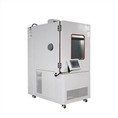


Products Description
The High Temperature Tensile Testing Machine is a reliability testing device derived from a tensile testing machine. By adding a high-temperature chamber to the tensile testing machine, it can perform mechanical tests such as tension, compression, bending, peeling, tearing, and shearing on materials like rubber, plastic profiles, and wire in high or low temperature environments. This testing machine is primarily used to test the tensile strength, compressive strength, elongation, and percentage elongation of various materials, semi-finished products, and finished products at different temperatures. It can also perform various mechanical tests at room temperature.
Features

Temperature Environment Simulation: The simulated temperature range typically ranges from room temperature to 300°C, with a temperature control accuracy of ±1°C to ±2°C. A uniform temperature field is achieved through resistance heating or induction heating.
Loading System: Utilizing a servo motor-driven ball screw system, it supports quasi-static and dynamic loading, with a maximum tensile force of 5kN. Select models support combined torque loading of 20Nm, and a loading rate range of 0.1-300mm/min.
Testing Capabilities: Covers tensile strength, yield strength, and elongation. Select models support creep testing, analyzing the mechanical behavior of materials at high temperatures through stress-strain curves.
Safety Design: Equipped with a double-layer explosion-proof observation window, an emergency stop device, and travel protection, it complies with international safety standards such as ISO 23788. The mechanical structure can stop loading within 0.1 seconds.
Application
The High Temperature Tensile Testing Machine can meet the testing needs of multiple industries:
1. Metal Materials: The High Temperature Tensile Testing Machine can be used to test the tensile strength, yield strength, elongation, and other mechanical properties of metal materials in high and low temperature environments. This allows evaluation of the performance and reliability of metal materials under different temperature conditions, providing a basis for material selection, processing, and heat treatment.
2. Plastics and Rubber: The High Temperature Tensile Testing Machine can be used to test the mechanical properties of plastic and rubber products in high and low temperature environments, such as tensile strength, elongation at break, and tear strength. This helps optimize material formulations, improve production processes, and enhance the quality and service life of plastic and rubber products.
3. Automotive: The testing machine is used to test the mechanical properties and durability of automotive components such as engine mounts, suspension components, and rubber seals in high and low temperature environments, ensuring safe and reliable operation of vehicles in various climates.
4. Aerospace: The High Temperature Tensile Testing Machine is used to perform high and low temperature tensile tests on aerospace materials and components, such as carbon fiber composites and metal alloys, to verify their mechanical properties and reliability in extreme temperature environments, thereby ensuring the safety of aerospace vehicles.
Differences from conventional tensile testing machine
1. Testing Environment
Ordinary tensile testing machine can only perform mechanical tests such as tension, compression, and bending on materials under normal temperature and pressure.
High temperature tensile testing machine, however, are equipped with a sealed chamber capable of simulating high and low temperatures, as well as alternating temperature environments. These machines can test materials within a set temperature range, such as -70°C to +300°C, providing a more comprehensive assessment of material performance under varying temperature conditions.
2. Testing Accuracy and Data Processing
The testing accuracy and data processing capabilities of ordinary tensile testing machines primarily depend on their sensors and control systems. However, high temperature tensile testing machine, because they require testing at varying temperatures, place even higher demands on the accuracy of their sensors and control systems. Their high-precision sensors capture real-time stress, strain, and other parameters of the specimen during testing, which are then analyzed and processed by software to generate detailed test reports.
Product parameter
|
Model |
BT-300B |
BT-600B |
BT-1000B |
||
|
Maximum test force(kN) |
300 |
600 |
1000 |
||
|
Accuracy level |
1 |
||||
|
Collection method |
Spoke load sensor |
||||
|
Piston stroke(mm) |
200 |
||||
|
Clamping method |
Hydraulic |
||||
|
Test control method |
Microcomputer servo control |
||||
|
Compression test space(mm) |
600 |
||||
|
Tensile test space(mm) |
700 |
||||
|
Total power(kW) |
1.5 |
||||
|
Compression platen(mm) |
Φ148 |
Φ198 |
Φ225 |
||
|
Round sample clamping range(mm) |
Φ10-30 |
Φ13-40 |
Φ13-40 |
||
|
Flat sample clamping range(mm) |
0-10 |
0-15 |
0-20 |
||
|
Bending fulcrum span(mm) |
50-300 |
||||
|
Bending heart / stick diameter(mm) |
50/50 |
||||
|
Number of columns (screws) |
6 column |
||||
|
Mainframe dimensions(mm) |
810*560*1910 |
880*570*2050 |
940*640*2250 |
||
|
Host weight(kg) |
≈1620 |
≈2000 |
≈2600 |
||
|
Control cabinet size(mm) |
1010*640*840 |
||||
|
Control cabinet weight(kg) |
150 |
||||
Hot Tags: high temperature tensile testing machine, China, suppliers, manufacturers, factory, buy, cheap


